
Get our latest blog posts direct to your inbox.
Raising the Standard: The VICTVS Conference 2026
On July 1st, we hosted our annual conference at the stunning Terrace venue in Leeds. This year’s theme, ‘Raising the Standard: Accountability in Assessment’, tackled a critical yet often-neglected topic: accountability. While accountability may not always take centre stage, it is the backbone of integrity, trust, and value in qualifications.
Accountability is the obligation that individuals or organisations have to take responsibility for their actions and accept ownership of any outcome, whether good or bad. In assessment, this can look like awarding organisations and assessment providers understanding how much their procedures can impact an assessment on a granular level, and taking responsibility when things go wrong. Without accountability, the entire assessment system would risk losing its value.
To explore accountability and its implications, as well as wider issues impacting academic integrity and assessment, VICTVS hosted a diverse lineup of speakers:
- Niamh Pierce, Head of Research at VICTVS’ research division, the Assessment Security Research Group (ASRG)
- Joanna Taylor, Head of Operations at International Well Control Forum (IWCF)
- Liz Sewell, Head of Operations at VICTVS
- Shaun Roberston, Director of Qualifications and Credentials at the Institute of Chartered Accounts in England and Wales (ICAEW)
- Victoria Morgan, Head of Assessment at City & Guilds
The day kicked off with an eye-opening presentation by ASRG’s Niamh Pierce on her latest research paper, ‘Candidates for Hire’, which exposed the impersonation methods some candidates use to cheat, including professional impersonation services. These services start at £20,000, highlighting the scale of the problem and how these services are often only accessible to those with money to burn. The talk sparked many questions from the audience on ID checks, and how awarding organisations can best arm themselves against this type of malpractice. For those wanting to read more, Niamh’s paper is available on the ASRG website.
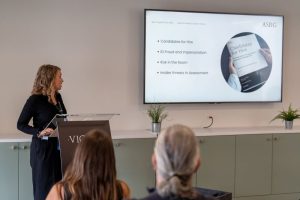
Joanna Taylor from IWCF then took to the stage with a sobering reminder that accountability in assessment isn’t just an abstract concept; it can have serious consequences. For those working in the oil and gas industry, an individual working on a rig without the proper knowledge is not only dangerous to those around them, but also the environment. Joanna’s session considered the importance of holding those caught cheating to account, as well as what constitutes an appropriate punishment. For example, how long should they be banned from taking exams in the industry? And should they face extra pressures and precautions from awarding bodies in the future? These were two of the questions prompted by Joanna’s talk which fueled conversations long into the lunch break.
Beyond the Talks
As well as hearing from our guest speakers, refreshments were provided throughout the day, including fresh ‘Brain Juice’ to help stimulate discussions. But the real highlight was the in-house entertainment in the form of VICTVS’ Beat the Cheat video game.
This retro-style video game challenged players to navigate a stressed teacher through an exam hall, catching cheating students in the act. The prize? A Kindle for the highest scorer. Inevitably, this led to some friendly competition, all while reinforcing the day’s themes.

Closing Sessions
After a sunny, roof-top lunch, we reconvened for the day’s final sessions.
First, we celebrated the VICTVS Global Network — our vital community of exam centre staff, invigilators, and quality assessors. Their work is integral to VICTVS and it was great to hear from members all over the world via video about their work with us.
We then heard from VICTVS’s Liz Sewell on the operational logistics of running exams in extreme conditions like harsh weather, political upheaval, or internet blackouts. This insightful talk was followed by a particularly thought-provoking session held by ICAEW’s Shaun Robertson.
Shaun’s talk considered the role of assessment design in preventing cheating. He challenged whether some exams should accurately reflect the conditions that candidates will be facing in the real world. For example, shouldn’t medical students be allowed to use emails during exams if that’s what they’ll be expected to do in the workplace? Shaun also argued for the importance of designing a course that accurately reflects the exam content. If it doesn’t do this, how can candidates be expected to succeed? His talk was a call to action for awarding organisations to take accountability for the systems and cheating opportunities they help create.
We closed the day with an illuminating session by City & Guilds, who covered the logistical practicalities of scaling assessments to support thousands of courses worldwide. For smaller awarding organisations, this talk was an insightful look into the efficiency, creativity, and organisational skills needed to be successful at scale.

Final Reflections
After a day of engaging talks and discussions, the VICTVS Conference came to a close with an early evening drinks reception. It was a great way to round off the day — and, for football fans, a chance to catch the World Cup game in good company.
With contributions from VICTVS, ASRG, IWCF, ICAEW and City & Guilds, the second VICTVS Conference highlighted both the complexity and importance of upholding accountability and integrity in assessment. More importantly, it reinforced the value of bringing professionals together to share challenges, solutions, and new perspectives. It is only by doing this that we can hope to find solutions to the problems discussed here.
As the assessment sector continues to evolve, the conversations started at this event will undoubtedly continue. We look forward to seeing how these discussions shape future practices and assessment design, and to welcoming attendees back for another day of learning, collaboration, and innovation next year.
To stay up to date with our work and any future events, follow us on LinkedIn and subscribe to our monthly newsletter.